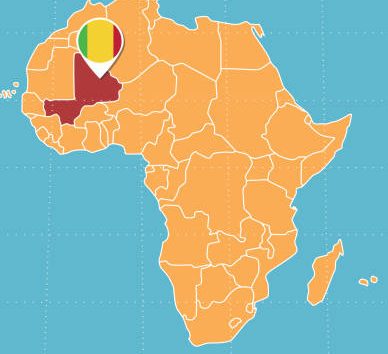
Mali map in Africa, icons showing Mali location and flags.
History of Mali
Mali is a country in West Africa. In 1960, the Sudanese Republic and Senegal gained independence from France as the Mali Federation. However, after only a few months, Senegal withdrew from the federation. The remaining territory, formerly the Sudanese Republic, was renamed Mali.Dictatorial rule in Mali ended in 1991 following a military coup led by Amadou Toumani Touré, paving the way for the country’s transition to democracy. Mali soon emerged as one of the strongest democracies on the continent.In 1992, Alpha Konaré won Mali’s first democratic presidential election and was reelected in 1997. Following the country’s constitutional two-term limit, Konaré stepped down in 2002. He was succeeded by Amadou Toumani Touré, who was later elected to a second term in 2007. These elections were widely regarded as free and fair.
Geography of Mali
Mali is a landlocked country located in the interior of Western Africa. It lies southwest of Algeria, north of Guinea, Côte d’Ivoire, and Burkina Faso, and west of Niger. Mali is slightly smaller in area than the U.S. state of Texas. The country has a subtropical to arid climate, characterized by three main seasons: hot and dry from February to June, rainy and humid from June to November, and cool and dry from November to February.
Economy of Mali
Mali is a landlocked country in West Africa and remains one of the world’s poorest nations. Its economy is heavily dependent on gold mining and agricultural exports, particularly cotton. Economic performance fluctuates with global commodity prices and weather conditions. Around 65% of the land is desert or semi-desert, and most economic activity takes place near the Niger River. About 80% of Mali’s labor force works in farming and fishing, and 10% of the population is nomadic. The country continues to rely on foreign aid and faces challenges such as poverty, youth unemployment, and climate-related droughts. Mali has worked to diversify its economy by developing cotton, iron ore, and lithium production, but insecurity continues to hurt tourism and trade. Despite reforms and IMF support, Mali’s growth outlook for 2025 remains modest, with poverty levels still high.



 Massok English Immersion School